
Account Settings
|
Field |
Description |
|
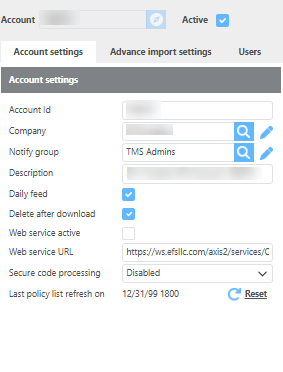
Account Id |
Enter the account ID from EFS. |
|
Company |
Select which of your companies this account's advances should be imported for. |
|
Description |
Enter a description for this account. |
|
FTP Active |
Check this box if the FTP connection is active. |
|
FTP uses SSL |
Check this box if this account requires SSL. |
|
Delete after download |
Check this box to delete the file from the FTP site after it has been downloaded. |
|
URL |
Enter the SFTP URL. Default: sftpus1.mft.wextransfer.com |
|
Port |
Enter the SFTP port. Default: |
|
User name |
Enter the username. By default, Ditat uses the same username and password for all EFS accounts and identifies customer transactions by account number. |
|
Password |
Enter the password. By default, Ditat uses the same username and password for all EFS accounts and identifies customer transactions by account number. |
|
Outgoing folder |
Enter the outgoing folder path if one is required. |
|
Web service active |
Check this box if you are using the second-tier EFS integration. This must be enabled by Ditat. Contact sales@ditat.com for details and pricing. |
|
Web service URL |
Enter the web service URL. Currently the same URL is used for all customers. |
|
Secure code processing |
Controls how fuel cards are secured with a PIN at the pump. Disabled — cards function normally without a PIN. Enabled with DMD — generates a PIN for drivers with a linked fuel card and sends it to the linked user. Cards not linked to a driver will function without a PIN. Enabled — generates a PIN for all cards regardless of driver link. The PIN can be retrieved from the EFS Fuel Card screen in the prompt section. |
|
Last policy list refresh on |
Displays the last time the policy list was refreshed for this account. Click Reset to run a manual refresh. The policy list is also refreshed automatically each morning on the same schedule as the daily fuel advance import. |
Advance Import Settings
|
Field |
Description |
|
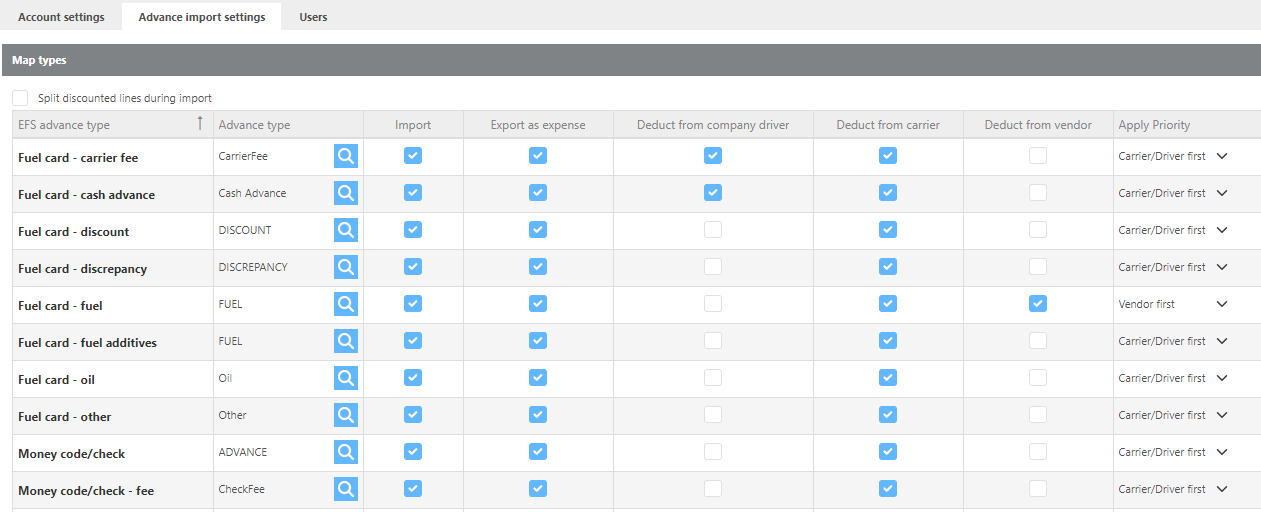
Split discounted lines during import |
If checked, fuel and discount amounts will be imported as separate lines on the advance so they can be mapped independently. |
|
EFS Advance type |
A predefined list of advance types that EFS may send over for your account. These types are set by EFS and cannot be modified. |
|
Advance type |
Select the Ditat advance type to link to this EFS advance type. |
|
Import |
Check this box to import this advance type when advances are imported. |
|
Export as expense |
Check this box to export this advance type to your accounting software when the batch is posted. |
|
Deduct from company driver |
Check this box to mark this advance type for deduction from a company driver by default. |
|
Deduct from carrier |
Check this box to mark this advance type for deduction from a leased driver by default. |
|
Deduct from vendor |
Check this box to mark this advance type for deduction from a vendor by default. |
|
Apply Priority |
Use this field to specify which party should be deducted from first if both a vendor and a carrier are listed on the advance. |
Example: If a leased driver and a vendor are both linked to an advance, the Apply Priority setting determines which party the advance is deducted from.
Users
This Tab will only be available when you have the Tier 2 integration.
|
Field |
Description |
|
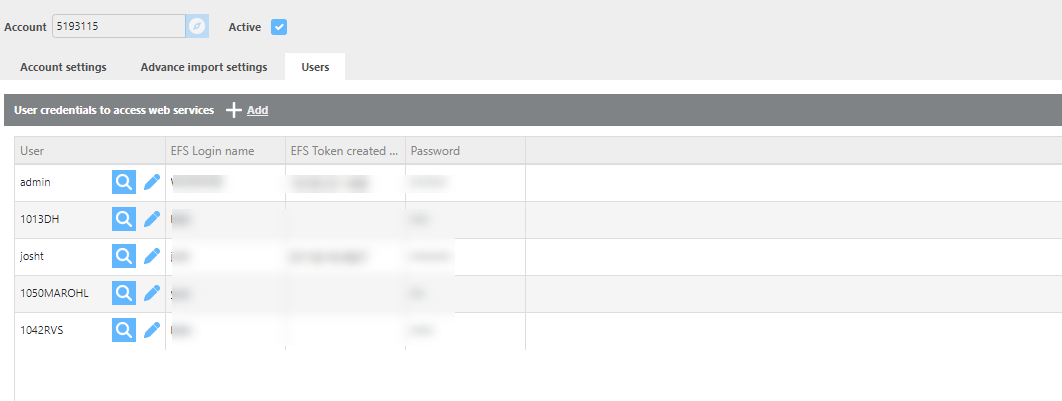
User |
Select the Ditat user who will be able to add EFS transactions in Ditat. |
|
EFS Login name |
Enter the EFS username for this user. Ditat will use this to verify the user's permissions based on what they are allowed to do in the EFS portal. |
|
Password |
Enter the EFS password for this user. |
EFS Tier 2 Integration Notes
-
EFS must enable Web Portal access on their side and allow the following IP addresses through their firewall:
107.20.195.8and54.242.172.61. -
For Fleet One accounts, the username must be prefixed with
FLT_. -
An EFS token is created the first time a user accesses the Real-Time Advances screen.
-
When money codes are issued, Ditat will receive files confirming they were generated. However, no advance will be created in the TMS until a file is received showing the amount used. This is because the money code can be voided in full or in part until it is actually used.